Interview with Matti Ben-Lev on “Phosphene”

by Regina Waters

Matti Ben-Lev is a queer nonfiction writer and poet from Baltimore, Maryland. He has been published by McSweeney’sRumpusX-R-A-YHADJake lit mag, and more. Matti was a part of Grub Street staff for Volume 72 and has contributed to Volume 74 and Grub Street Online. He is currently pursuing his MFA in nonfiction from George Mason University where he is the assistant nonfiction editor for their intersectional feminist literary magazine, So To Speak. I had the pleasure of interviewing Matti about how his creative nonfiction work “Phosphene,” published in Vol. 74, came to be. 

This interview was conducted over Zoom by Regina Waters and was transcribed and edited for clarity and length.

Regina Waters: What inspired you to write “Phosphene”? 

Matti Ben-Lev: I have been working for the better part of three years on a memoir that largely centers my mom and our Greek and Jewish heritage. I tend to write in vignettes, regardless of the size of my project. I write in sections and collect memories, and a couple of the things that I wrote for that memoir I really liked and pulled them out to create flash pieces with. “Phosphene” was one of them. 

For the arc of the memoir I’m working on, I was trying to show moments where I could pack context into a scene, rather than context dumping. “Phosphene” was a pretty foundational piece because I realized I can capture so many things. The original piece was longer because it was meant for this other work of capturing something about heritage, something about my grandfather, and the idea of passing something down. 

My grandfather taught my mom how to take a picture with her mind. Originally, I had it in there, but with flash I could capture the context of when this was happening and the context of myself in relation to my sister and my mom, and convey such a vivid memory. So many memories are subjective that we can doubt them, and that memory, because of how my mom taught me to remember it, stands out so vividly—I feel like that memory is stronger than something I experienced a month ago. That’s the inspiration for that piece: It was a way to fit context into a scene. I love vivid imagery and language, and when I was editing it to flash, because it was such a limited space, every little piece had to do something for the work. 

When it comes to flash, you want there to be a turn and every single sentence and word to serve the piece and the subject to fit in such a tight container like that.

RW: You shortened “Phosphene” for publication. Can you tell us about your writing process? 

MBL: I went through and made sure that every single sentence served what I was trying to say. I also had a couple more section breaks because there was more context in the original. I was really asking myself, “What can I delete that will allow me to still tell the same story of this memory?” When I got down to a certain point, I asked myself, “What context is in my larger project that contextualized this piece that I need to still do that work in this piece?” 

I was mainly stuck where there was a little bit more explanation about certain things like Varkiza, but I essentially just tried to capture that moment with as little context as possible. So, it’s trying to be one powerful scene where there’s a little context as is necessary to understand the piece. 

I’ve heard this from flash fiction seminars I’ve been in: the narrator or the protagonist is supposed to be different from the one who started the narrative. I was thinking about that a little bit as well, like, “how can I imply that there’s a difference?” That implication is zooming out. Some people would call it the turn. Like, “oh, this is a memory that I still have very vividly, where I can remember the sounds and the smells.” You look at the name “Phosphene,” something that when I close my eyes I can still picture, and so I was trying to do that work in a flash piece because that work was already done or going to be done in a longer work. 

RW: What craft elements did you implement in Phosphene after learning them from your time with lit mags? 

MBL: This piece was written before I started working for So To Speak, but I was leaning on the imagery. One of the things I learned from a bunch of different sources—like Grub Street, being a poetry editor—is the reliance and importance of really strong imagery that sticks and really surprising language in that imagery. I don’t think that this piece was heavily influenced by what I saw. I think if I were to write flash today, it would be very influenced by what I’ve read in So To Speak

RW: “Phosphene” relies on nostalgia and imagery. How do you typically write nostalgia? Did this piece require a different approach? 

MBL: I think with nostalgia it’s very easy to wane into the overly sentimental and overly emotional. While writing should be emotional, you need to understand what’s going on, and it needs to be able to make the reader develop that emotion you’re writing. Especially in flash, where so much of it happens in the action. You want the reader to kind of come to this specific emotion or sense on their own. 

George Mason has this book festival every year, and fiction writer Lydi Conklin came and someone asked them, “What was one of the things you wanted the reader to feel?” Lydi said they wanted their readers to cry. And so, somebody asked a follow-up question of, “How do you make a reader cry?” And Lydi said that telling a reader “This character cried,” will never be as impactful as that character holding in all of their emotion and desperately trying to not cry and bottling it up. The action of crying isn’t particularly surprising, and the reader won’t need to cry because the character is doing that work for them. Lydi’s like, “How do I make the writer do the work for the character?” When I was writing “Phosphene,” I didn’t want to wane into the overly sentimental. I wanted to establish the importance of this memory by highlighting its vividness, not by telling you how I felt. There’s room for that interiority in longer nonfiction, but not much when you have a limited space. I was thinking, “I want to hit hard, I want to hit quickly, I want the reader to feel a certain emotion, and I don’t want to tell them this is what I felt.” For example, with the line, “we’re getting some time together, we haven’t had much since my sister was born,” I’m establishing the context of the importance of this memory without leaning into the overly sentimental or telling you I am being nostalgic. 

RW: In the first sentence, you set the scene and introduce the main characters as you and your mother. Why did you introduce these two main characters in the first sentence, rather than the second sentence? 

MBL: When you’re writing in such a small space, you need to give all of the context up front as quickly as lyrically possible. I wanted to establish where we were and who we were early, because I’ve read loads of flash, a lot of which I thought was pretty unsuccessful. One of the big pieces that is missing is not establishing context really early. Context needs to be really early, even in longer pieces.  

I recently submitted a standalone essay to one of my professors, and in the second paragraph I give introductory context. He literally drew a circle around it and said it needed to be in the first few sentences. This was a full 20-page essay. He’s like, “no, first paragraph.” I’m not saying I wholeheartedly agree with that, but in a piece like “Phosphene,” you want the reader to want to spend time with the narrator, even in such a small space. It doesn’t mean they have to root for the narrator, but you want them to feel like, “this is someone that I want to spend the next 500 words with. I’m going to spend the next couple pages with them.” Part of that is giving that context up front. So, I was intentional when I said “overlooking the rocky beach in Varkiza.” I’m not saying a rocky beach, I’m saying the rocky beach. I’m already setting context, I’m already trying to indicate, “this is a place that I have gone with my mother previously.” 

I’m trying to give you my age, and then sensory details to ground you before I go into the narrative, and I want to give that information as quickly as possible so I don’t lose the reader. I had to edit a piece for it to be a flash piece, and I asked myself what context needs to be given. I thought I should put that context in the first two sentences. That was the technical thinking. 

I always think of that poem “The Red Wheelbarrow” by William Carlos Williams: “so much depends / upon / a red wheel / barrow / glazed with rain / water / beside the white / chickens.” It could be “my family depends upon…,” “my livelihood depends upon…,” but it is “so much depends / upon / a red wheelbarrow.” I always think of those lines and the idea of the specificity of the red wheelbarrow and the abstract of the words “so much.” So much depends on it. I think about that a lot when I’m writing: “How do I leave that space open for the reader to fill and seek with their own mind?” That’s what I was thinking when I was writing “the rocky beach,” rather than “a beach in Varkiza.” I wanted to ground the reader and invite them to imagine there is one rocky beach in Varkiza, even though it’s not true.  

RW: You’ve personified the ocean by writing, “the azure waves pulling in so fiercely it appeared they’d never release, and then thrusting water toward the rocks like a hug—holding tight and letting go.” Your imagery is evocative and imaginative and resembles the coming and going of memory and images. How did you know that you wanted to use the ocean as a vessel to convey this feeling? 

MBL: Pretty immediately I realized I wanted to personify the ocean. Emotion between child and parent is not surprising. You can do it really well, but it doesn’t really subvert expectations. So, I was thinking about some of the work that I would do between my narrator and myself and my mom, and how I can put that relationship in imagery. I think when you’re working with flash there’s not as much room for that exposition or interiority. So how do I put that power and meaning onto something bigger? For me, and I think for a lot of people, there’s already something parental about the ocean, even maternal.

The waves receding and pushing back can mimic a lot of relationships. And I was thinking, “Does it mimic this relationship? How can I make it do that work?” It’s almost like the giving and pulling back of affection and love and connection and all the other things that go into any relationship. There is a push and there are moments where we’re on, moments where we’re off. So, I wanted to do that work and demonstrate that relationship without telling you, “Here’s what it felt like when I was a child, here’s this, and this and this happening.” How can I put that work on something much bigger than us that I can use imagery to paint in a beautiful way? 

So, personifying the ocean came pretty much the moment I started writing this. I realized I wanted the ocean to represent parts of this relationship, so I don’t have to say it. Even down to the end, “thrusting toward the rocks like a hug—holding tight and letting go,” I was thinking that would be more impactful than, “like a hug from my mom—holding tight and letting go.” If I just went with that image, I want the final image to be the water crashing on the rocks and pulling back and repeating this cycle, and then to connect point A to B. The ending also came really early for me. I wanted to put this feeling on this water, and this motion, and this action. The last image that I leave readers with is not my mom and I hugging, it’s the water crashing and saying, “This is what it’s about. This is what I’m pointing to.” 

RW: Since you established the sea as a main image, what is your relationship with the sea and what does it represent to you as a writer? 

MBL: This particular beach represents a lot to me as a human, rather than the sea. When I was a kid, I would go to Varkiza, my grandparents lived there; my whole mom’s side of the family is Greek, and pretty much every summer up until I was 13, we would go and stay in Varkiza. Sometimes for a month or two. I would go to this beach every single day. And there’s no sand—it’s all rocks and it’s free and it’s hard to navigate, and there are so many memories there. 

I recently wrote an essay, which I hope to get published soon, about my grandfather. He would take me to that beach every single day. I would stare at that water, and I would jump off this huge rock that you can kind of launch yourself off. My mom really did not want me to do it when I was a kid. I did it anyway. She ended up telling me she did the exact same thing as a kid: Her mom did not want her to jump off that rock, and she did it anyway. And so it’s really this beach in particular. I have so many powerful moments with this beach. I look at it as a setting that can do a lot of work for me because in my life it’s done a lot of work for me.This is a meaningful place where a lot of my connection with family and heritage comes in. So, I think whatever setting we can use as something that’s impactful to us and our story, I think we use. 

RW: You have a lot of dialogue for a flash nonfiction piece. How did you decide to incorporate this dialogue, and did you remember it as you wrote, or did you move things around? 

MBL: I hate writing dialogue, especially in nonfiction. I’ve seen dialogue done really well in fiction, but as a reader, I have a really hard time suspending disbelief when reading dialogue. Even in fiction, characters don’t have unique voices, and more often than not, they do. It’s a personal grudge. This is probably the most dialogue I’ve had in anything I’ve had published. Usually, I don’t even like quotation marks. I like using italics for dialogue. I find dialogue unconvincing, and writing dialogue is very, very hard for me. 

This piece wanted dialogue. It felt like I’m centering this relationship, so there needed to be some dialogue, for my mom to have a voice. And I was also thinking, since the voice is a 9-year-old, I want you to take a step back with me, away from Matti as a writer who’s 30, and sit in this 9-year-old’s memory, which is why I use the present tense. One of the ways I do this is by establishing a voice via dialogue. Honestly, knowing more about dialogue and voice and character now, I would probably change some things to make the voices a little bit more unique. 

The truth is, with nonfiction, unless you’re writing about your life, there’s really no such thing as nonfiction because memory is so subjective. When I wrote this piece and sent it out, I read it to my mom and she remembers this differently than I do. She remembers some of the things that were said, where we were, what was happening, and the emotion differently. So, really, when you’re constructing dialogue in nonfiction, all of it is an approximation of the truth, and the internal question we have to ask ourselves is, “Is what I’m conveying honest?” I think we have a duty as nonfiction writers to uphold a type of emotional honesty. “Is this true to the story? Is this true to the emotion?” Rather than, “Does this dialogue map exactly what happened?” 

This was 21 years ago. The dialogue is not exact, but this is how I remember it for the most part; it’s an approximation. I have that line, “I can tell you how to take a picture,” and I cut my mom off. That really captures my 9-year-old voice with my mom. Like, the me know-it-all, “I know what you’re gonna tell me,” and her saying “you’re wrong, that’s not what I’m gonna tell you, let me finish.” That feels authentic to our personalities and our voices as people, rather than, “Did every line of dialogue get said like that?”   

Regina Waters is a senior at Towson University pursuing a degree in English. She currently serves as the Editor-in-Chief of Grub Street Online.

Interview with Matti Ben-Lev on Writing and Editing

by Regina Waters

Matti Ben-Lev is a queer nonfiction writer and poet from Baltimore, Maryland. He has been published by McSweeney’sRumpusX-R-A-YHADJake lit mag, and more. Matti was a part of Grub Street staff for Volume 72 and has contributed to Volume 74 and Grub Street Online. He is currently pursuing his MFA in nonfiction from George Mason University where he is the assistant nonfiction editor for their intersectional feminist literary magazine, So To Speak. I had the pleasure of interviewing Matti about his experiences with working at lit mags and writing. 

This interview was conducted over Zoom by Regina Waters and was transcribed and edited for clarity and length.

Regina Waters: You served as the social media editor and an assistant poetry editor for Grub Street. Now, you are the assistant nonfiction editor at So To Speak, an intersectional feminist magazine run by George Mason’s MFA. What did you learn from these experiences?  

Matti Ben-Lev: Mainly, I learned a lot about how lit mags operate. I learned about the slush pile, I learned about weeding through submissions, I learned about when edits need to be made, and how you have that conversation with the writer. For example, we had a poem that looked like a prose poem, and our EIC was trying to fit it on the page in InDesign, which was crazy difficult. In the end, we wrote to the author and asked, “Are you okay with us changing the line breaks?”  

And another poem that I still love, “How to Deal with a Brick,” looks like a wall of text with chunks missing, forming the appearance of a brick wall. We accepted it because we loved it. Our GS advisor sat with a TA for something like 8 hours trying to format this one poem!

So, I learned a lot about the behind-the-scenes work that goes into making a good lit mag. Something I saw while working for Grub Street that I carried into my work as assistant nonfiction editor at So To Speak is the impact of my voice and opinion. I loved how I could champion a piece that I wanted to accept, and seeing that my voice makes a difference. For example, when I was a reader for So To Speak, there was a really good piece that I liked called “Mushroom Clouds” that others were on the fence about, and I convinced them to accept it, and it got published in our last print issue. It was a similar experience with Grub Street

Through my experiences at Grub Street and So To Speak, I learned a lot about developmental and copy editing. I did not realize the vast difference between developmental edits and copy edits, and how you go about making those edits and communicating with the writers. Of course, writers have the ultimate say in those decisions. It’s a fine balance between editors knowing that changes can make a piece better and making sure the writers still have agency.

I also learned how frustrating it is when you’re about to accept a piece, and the writer pulls it because it got accepted elsewhere. 

At So To Speak, for each genre, we have one “panic-button” acceptance, where we can just snag one piece immediately before it is published somewhere else. So, for our upcoming issue, we found a piece, and we just snagged it in a day. Now, we’re all bouncing back and forth and talking about the edits that need to be made. I also like the fast pace and being around art. Being exposed to art I wouldn’t otherwise read is really neat. 

RW: How would you define developmental edits? 

MBL: I see developmental edits as anything that goes outside the box of punctuation. I even consider changing a line break in a poem to be a developmental edit. 

A big edit changes the meaning of the piece. You can argue punctuation does the same thing, especially in poetry, but punctuation usually shifts how you read something or how a specific line lands. Developmental edits work differently. Take the piece we snagged—we’re suggesting we cut the last line because the penultimate line hits harder. I’d call this a major developmental edit.

I, and So To Speak, believe that if we accept a piece, we’re willing to publish a piece as is, and any edits that we suggest, the writer can veto. 

RW: What advice do you have for aspiring lit mag editors?

MBL: Be a reader first, if you can. It was helpful for me to be in a backseat role for a while. I read for George Mason’s two lit mags—So To Speak and Phoebe—before applying to be an editor. I think it’s helpful to observe people who know what they’re doing. And of course, when you become an editor you realize that actually none of us really know what we’re doing! I guess that’s the mirage of working with art. What I didn’t realize when I was submitting to mags—before working at one—is how chaotic the backend is. 

That’s my advice: become a reader first. There are lots of good magazines that anyone can apply to read for. I have friends who read for Ploughshares, Rumpus, X-R-A-Y, Jake lit mag. It’s not hard to become a reader for a decent magazine. Just don’t expect to get paid for it; you get paid in the experience. 

It’s an immensely rewarding process, and the truth is—and I think most people will admit this—we don’t necessarily read every word of every piece that comes in. We get works that are 5,000 words. If by the fourth page we know we’re not going to take it, we won’t keep reading. A lot of magazines are like that. There’s a flash magazine that I’ve submitted to 7 times before I got published called HAD. They usually cap at 150 submissions, so pretty much within a minute of them opening, they hit the cap. They go through subs within 3 hours, so their rejection process is quick.

RW: In reading submissions for any genre, what craft elements did you decide to incorporate in your own writing or try to emulate?  

MBL: A lot of my essays and poems start by mimicking what other writers are doing. That goes for pieces I read at Grub Street and So To Speak, and my peers’ work. I ask myself, “Can I borrow their form? What are they doing that I admire?” This often resulted in unique pieces that look nothing like the original work that inspired me. 

So To Speak accepted a piece that plays with a Greek myth and uses mythology to stand in for a situation in the narrator’s life. That’s something that I read and asked myself, “How can I play with that idea in my own work? What myths can I use to stand in for a situation in a meaningful way?” 

When I worked for Grub Street, there were some pieces we accepted that I definitely tried to mimic or borrow from. Borrowing form is very generative for me. So I often think, when reading: What can I borrow from this form? What inspires me about this piece? 

RW: In your 2023 interview with Professor Jeannie Vanasco, a memoirist and this year’s faculty advisor, you asked her what GS meant to her. She said she loves it when students find meaning in the lit mag and everything that goes into producing it. What did you enjoy about working on Grub Street? Has that meaning changed for you? 

MBL: The sense that my voice really mattered and doing work in a way that felt not-performative. I’m sure there’s a better way to state that! I also just like being around art. I like having conversations about art, I like questioning it and hearing from our readers about what stands out for them in a given piece. 

On the more stressful days, it can be like, “Okay, let’s look at this piece” and, “Okay, we have 10 more pieces to get to in this hour. Let’s see where we’re at.” When you slow down, you get to read pieces you wouldn’t otherwise read, which makes you think outside the box as an artist, and getting to participate in art and it passing through your hands is a really magical and powerful experience.

RW: How would you describe your writing niches, if you have any? 

MBL: I think I can be really funny, and this memoir and what you just read, and the poem that y’all accepted does not fit with this, but I like writing about politics, and I like humor. I think those are some niches that I’ve discovered more recently. I wrote a short story recently that got published that has a lot of humor in it. I’ve written a lot of political satire. I like that kind of stuff. I like writing about politics to point out the absurd. Outside of that, I think it’s strong imagery, writing about people and relationships, and trying to do that work without telling you I’m doing the work. “Phosphene” is a perfect example of that. “How can I do the work that the ocean is doing without telling you what it’s talking about?” You just kind of infer. 

I’m a sucker for lyrical writing. I think that lyrical writing is the niche that I hope I fit. I like flash, although I’ve kind of taken a step back to invest time in longer works. And political satire is almost like a much-needed comedic relief from the harder writing, which is very emotional, and, also from the world we live in, it feels I can almost take a break by pointing out the absurd. I wrote a piece that got published in McSweeney’s. It was written as a letter from the Department of Homeland Security to send in Optimus Prime to combat protesters. McSweeney’s took that. I was overjoyed. But I’m literally watching democracy crumble, and that’s a way that I can find a light in the absurd. It is not the same as actually taking action and going out there and protesting and organizing food drives. I’m not gonna compare the two, but it does feel like an act of artist resistance because I think all art is inherently political. Even if you’re not talking about it, you’re creating art within a political world, and so all of it will be political. 

RW: How much verisimilitude do you think a writer should aim for, especially as time passes and our understanding changes? I define it as how real the truth can actually be.  

MBL: The memoirist Mary Carr wrote this craft book about memoir, and she talked about when she was teaching creative nonfiction at a university. On the first day of class, she would stage an incident where another professor would come in and scream at her, throw her stuff on the floor, start this loud argument, and then walk out. And the whole class is shocked. She’d be like, “That was staged, I want you to take out a piece of paper and write out everything that you saw happening when you thought it was real.” She collected them and then a month later, she had them recount the exact experience they saw, and then handed them back the sheet of paper. They all basically wrote different things like clothing and items being broken, except for a couple people who had photographic memories. I think there’s no such thing as pure honesty. We can both agree that a table is a table, and a chair is a chair, (that’s a Jeannie line), but outside of that, truth is so subjective. I think we owe it to our readers to be emotionally honest.   

I’ve written some things during the pandemic when I was living with my parents for a while that I’ve recently gone back and read, and I’m like, that’s not true or real. Like, now that I have the remove, I can see that’s not really how that happened. So I think we have that duty to be as honest and close to the truth emotionally as possible and not change a situation.   

You can have that kind of speculative sense in memoir and nonfiction, and in poetry since you have more room. I don’t think there are those lines in poetry. I’ve definitely written poems that are more confessional and more non-fiction-adjacent, but I’ve also written poems where I’m just trying to convey an emotion and what happens in them isn’t true. 

I think with nonfiction, we do have that duty to be as honest as we can be, and just acknowledge that truth is also very subjective. I shared the original draft of “Phosphene” with my mom, who’s a central character in that piece, and she explained, “I remember this moment, that didn’t happen exactly like that.” We have a lot of latitude by using words like “maybe” and “perhaps” and a duty to the people that we’re writing about to be as emotionally honest as we can be, especially if they could get hurt by what we write. 

RW: What makes a work successful?

MBL: I took this flash course with this really awesome flash writer, and I asked, “How do I know when this piece is done? I’ve been editing it, and it’s something that got published a while ago.” I wrote it for the memoir and took it out, and realized this is a flash piece, and it works really well. She quoted this director who answered, “How do you know when a movie’s finished?” He said, “When it gets released.” So, I think it’s kind of the same thing with this. “How do I know when a piece is done?” Because it is published. 

So, whether it’s successful or not, I guess I hear from people their thoughts and know if it’s successful, is it conveying what I want it to convey? There are times I’ve written poetry and prose, and someone goes, “wow, you really indicated such and such.” And I’m like, “Not my intention, but I’ll claim the credit.”  

I think a lot of the decisions we make in writing we make because it feels right and then justify them later. So when a piece feels successful, it’s like, “Did I make you feel something? What did this mean to you? Did you read it?” If you read it, that’s successful. Even if you didn’t like it, if you read all of what I wrote, that’s a success. 


Regina Waters is a senior at Towson University pursuing a degree in English. She currently serves as the Editor-in-Chief of Grub Street Online.
Interview with Matti Ben-Lev on “Of Jamie”

by Regina Waters

Matti Ben-Lev is a queer nonfiction writer and poet from Baltimore, Maryland. He has been published by McSweeney’sRumpusX-R-A-YHADJake lit mag, and more. Matti was a part of Grub Street staff for Volume 72 and has contributed to Volume 74 and Grub Street Online. He is currently pursuing his MFA in nonfiction from George Mason University where he is the assistant nonfiction editor for their intersectional feminist literary magazine, So To Speak. I had the pleasure of interviewing Matti about how his poem “Of Jamie” came to be. 

This interview was conducted over Zoom by Regina Waters and was transcribed and edited for clarity and length.

Regina Waters: Can you give us a quick overview of what “Of Jamie” is about? 

Matti Ben-Lev: One of the things I love so much about poetry is that you don’t really have in nonfiction is the luxury to obscure meaning. When I’m writing for or thinking about publication, there are topics I won’t go into because I know that anyone I bring it to will say, “You need to go more in-depth on this topic.” I feel like, as writers who write about things that are true, including fiction writers who also write about true things, we have some duty to try to protect the people that we’re talking about who don’t necessarily have a voice.  

So, for me, this poem was about setting an emotion about a friendship that kind of fell apart when the person in the poem started to get really sick and unwell. I wanted to convey the depth of that relationship and convey his experience without claiming it. Instead of saying, “oh, I know all about it, let me write nonfiction about it,” I wrote what I observed in images, and then what it meant to me. I wanted to use language as the vehicle to get you to feel this tension and breaking apart and power in this friendship, rather than explain exactly what happened and what the meaning is.

 I tend to write poetry as a mostly nonfiction writer these days. My poetry is pretty confessional and straightforward, and you can kind of tell what it’s about. So about 6 months ago, I started reading some other work where a brilliant poet wrote a series of images, and then made meaning out of them. I thought that was really interesting. And so, I started trying to write poems that were more image-based and more based on conveying emotion through sound and form and images and language, rather than just through story. I think that’s how this poem and a series of other poems I’ve written since then have come to be. 

RW: What inspired you to write “Of Jamie”? 

MBL: I have a lot of experiences. I write a lot about these experiences, I have a history of addiction, I got sober 6 years ago, and it’s pretty open—it’s all over all of my writing. There are a lot of experiences that I’ve used writing to make sense of. So, I think a lot of the poems and pieces I write, especially poems, are trying to make sense of something from my past that doesn’t make sense or doesn’t have an answer and almost convey that on the page. I think “Of Jamie” came from me trying to make sense of this. 

Four years ago, I basically wrote a version of it which had only a couple of the images. When I really started writing a lot of nonfiction, it was for me to basically make sense of this. I don’t necessarily know what I’m gonna write before I sit down to write. I can have a general idea that I want to work on a project that I’ve been working on, but when it comes to a poem or starting a piece, sometimes I’ll sit down to work on one specific thing and write something else. Sometimes it feels like I don’t have a lot of control over that creative energy, although I have some. So, I read a bunch of those poems from that poet. I didn’t realize that this is the poem I was gonna write until I was sitting down and creating these images. I realized, “Oh my god, I’m creating images of this time in my life with this person.” 

RW: What was the process of writing “Of Jamie” like for you? 

MBL I started by collecting images. I wanted the images to show a change. I wanted them to start a certain way and show change as a situation specifically got darker. I’m watching some negative things happen with this person, I’m watching our relationship deteriorate, and I’m watching his relationship with his family change. I wanted to show that change happening over time in images. So first, I started by collecting images and starting a certain way, and the pieces that come at the end of each section appeared last where suddenly I’m piecing these things together to show a change, and then I’m trying to almost make sense of those images in that situation in those lines. 

Originally they were not indented that way. There weren’t sections. I just had a space in between each section. The sections came from showing this poem to a dear friend of mine who suggested breaking this into sections. It will make each piece stand alone, stand out more as more impactful when you utilize this space. I don’t think space is always the answer. I think it’s really tempting to play with space, and then a lot of us end up just taking it out when we’re editing unless it fits the subject or theme we’re talking about. And I thought the space worked really well here. The numbered sections were probably the last edit I did, where I was adding the numbered sections. At first it was collecting images, making sense of the images, and playing with space, which came in at the very last minute. 

RW: What does your poem mean to you, and did the meaning or goal change as you wrote? 

MBL: I think I’m never really thinking about a goal when I’m writing. I guess the goal would be publication or finishing the piece. In a broader sense, the goal is conveying what I want to convey in as meaningful a way as possible. I think that’s different for me with poetry. Because really, I’m trying to convey and capture an emotion or a situation, or just how something felt in a sensory sense, rather than the story and everything that happened. For the goal of that piece, I was thinking, “I want these images and my meaning-making to allow the reader to have an experience that follows the emotional experience that happened in the relationship.”

RW: “Of Jamie” is an emotional timeline of what happened to Jamie, and how they changed as things occurred. How did you make space for your feelings as you wrote? Were there any techniques you developed or adapted for yourself? 

MBL: I think this comes up in nonfiction a lot, like, “How do we write about these experiences that are really difficult to write about and think about?” I was at a conference, I think it was the Baltimore Writers’ Conference around two years ago, and this brilliant nonfiction writer, Athena Dixon, was leading a panel. She was talking about having a drawer—I think she had a physical one, but at least metaphorical—when writing about these really difficult, traumatic, challenging experiences in the past. When you’re starting to work on a project and realize “I’m not ready yet,” you can almost put it back in the drawer. I think that’s very, very true in nonfiction, and I think it’s similar in fiction.  

When these situations that I wrote about were occurring maybe three or four years ago, I was writing to make sense of it, and I was saying, okay, that’s not gonna see the light of day. I wrote a poem called “Of Jamie” at the time that I kept working on and off, and was continuing to stash it in the “Do Not Disturb/not ready yet” drawer. And I sat down to write a piece that borrows a form or a style that another writer’s using, and this kind of just came out. So it’s almost like I didn’t know that I was ready to write this until I wrote it. 

Once it was written, I would say because I was ready, the space I needed to make for myself was putting it down on the page and looking at it objectively, and trying to make it the best that I could. 

For me, there’s an amount of emotional processing that happens in writing, and then there’s, “Am I writing in a way that’s almost unhealthy?” Anything I write, I tend to write pretty obsessively. This goes more so for essays because I can spend longer in them. I obsess about it—it’s what I think about, it’s what I dream about. I’m researching what I’m writing about, even if there’s not necessarily a research component. I’m reading and thinking about things that other people are doing. It’s almost like it starts to occupy my day. It’s like I’m living my day with that piece of writing that I’m working on. And I think there are times when I’ve needed to put that down and give myself a break. When I was writing “Of Jamie,” I called Jeannie and asked about her experience of writing her second book and how she processed emotion, and we’ve talked a lot about that. She said going on walks and swimming, and being willing to put it down and pick it back up as needed. I think with poetry, because I had processed this, I didn’t have that experience. 

RW: What did you have the most difficulty with when writing “Of Jamie” and why? 

MBL: I think picking images that were not repetitive, picking images that I loved, and playing with image patterns. I think I refer to the Tonka truck and the toys in the playroom twice. I wanted to make sure that I noted the change in an image without making it repetitive, stale, or boring. 

The biggest challenge was at the end. I walked away with this poem, and I was honestly thinking, “my past poems are very confessional, very straightforward, you can tell what something’s about.” And I took this to my friend who’s a poet, and she said, “Matti, this is a little too cryptic. I want to get a little bit more of a sense of what this is about,” which made me laugh. As a prose writer who was experimenting, that made me chuckle. So, there were a couple lines toward the end that I added because I wanted the perfect amount of the reader knowing enough to understand the power of the poem and the images, but not so much that I was telling a story and spelling this out for them. I guess it is, in a sense, telling the story, which is something I liked about indenting the lines. I wanted there to be this movement through images.  

I think the hardest things were how much to actually give the reader in regard to context, what’s really happening, and what this is really about. Also, how to move somebody through the piece and make the images repetitive enough that you can see meaning in them, but not so repetitive that they’re stale. And honestly, I used to be so ashamed to admit this, I’m a thesaurus guy. I will look up synonyms. If I feel like, “I’m using this word too many times,” I will find synonyms online. Word choice, the fine-tuning is something that I really like doing, but it’s always a little bit challenging. 

RW: Was there anything you had to sacrifice when writing or updating “Of Jamie”?

MBL I had to sacrifice what I wanted it to be. I either wanted this piece to be much shorter or much longer. And so coming to where it is, I intended for this piece to be shorter and to take up less space. I think working in the lit mag world, as I’m thinking about submitting, and especially when I’m submitting to print magazines, I am thinking about how much space I may take up. When it comes to things online, I don’t think it’s as pertinent, but even if we’re writing a nonfiction piece, and the word count fits what a magazine wants but we play with space a lot, if it’s gonna be in print, that space, that economy, means a lot to editors. I don’t really think about it when I’m drafting new work. I don’t think it’d be productive for me to think about that, but when I was kind of coming backwards with this piece, I think those are some of the changes I made. Originally, there was much less white space in this piece. And I was thinking about lit mags when I was doing that, and I only added more space at the encouragement of a friend. 

RW: Spirituality and trust is a recurring motif in your poem. What does spirituality represent to you in the poem? How do you see it interacting with trust? 

MBL: When I was incorporating this piece of spirituality, I was trying to get at the spirituality of trusting somebody, but I was also trying to communicate the idea of worship almost as a way to look up to another person and how every human is incredibly fallible. When I said God in brackets, as the person who experienced it, that is what I meant, but I also wanted it to be a stand-in for something to worship, which is why it’s in lowercase and in brackets. I wanted to convey that sense of trusting, looking up to somebody almost as a form of worship. That’s why I also had the images of the statue there, because I was thinking about worship and looking up, and a statue kind of does that double meaning of somebody turning to stone emotionally, or someone turning away. There’s that emotional stone-turning, and there’s the bottom of worshipping something bigger than you and finding out that whatever you’re worshiping is fallible. 

RW: You incorporate nature and statue imagery, connoting life, restriction, and frozenness. What choices did you make when introducing these motifs? Especially in the ways they lent themselves to the poem’s structure? 

MBL: I feel like there’s some things that I love in my personal life that I don’t like writing about. And funny enough, nature is one of those things. Nature writing does not enthuse me as much as I wish it did. But for this piece, I had this image of the forest somewhat taking somebody. I’m imagining an illness as a force outside of somebody, and I’m thinking about my experience touring abandoned places and seeing vines wrapped around statues and things. Almost like seeing time eat this thing that once was used.   

I really liked that image as a metaphor for a relationship. This piece is not so much just about the person as it is about that relationship. Today, everything is good in that person’s life. I was really writing about this relationship and this dynamic and the image to me, which is kind of why I brought in the image of God. God is something that is static. God is something that means something very different to me than it might mean to anybody else, so I kind of was looking at this sense of worship, looking up to and imagining this outside external force taking that thing away as nature does naturally. Pun intended. 

RW: You have a lot of wonderful imagery that helps set the scenes and bring your audience in. How did you or your poem decide what images belonged? Were there any that did not quite fit that you had to tweak or shelve? 

MBL: Yes, there were a lot. When I write anything, minus some of the fiction I’ve written, I tend to write in vignettes of text. That goes for poetry. I’ll write lines, I have notebooks full of lines that have never become poems, and lines that have gone into a poem. And so, when I started writing this, I really was collecting images. Until I started collecting images, I didn’t actually know what this really was about. Then I was collecting more images, and I was thinking about our relationship, and I was thinking about nature and how nature demonstrates time, how nature changes over time, especially when people don’t interfere with nature—it will grow around things. There were a lot of images that I felt represented myself and my subject and this relationship that didn’t belong here. For example, I had a bunch of imagery about coffee cups and coffee because that felt like a totem in this relationship in a weird way, and it didn’t make it into the piece. In Section 6, “chair folded out at the room’s tip / seat kissed ash green / like the greenery around your waist, swollen,” that’s the first section that directly jams into the next section. That “chair-folded / ash green,” I tweaked that like crazy but I’m still not super satisfied with it. There are a couple other places, too. “painting in your foyer / bruised at its folded edges.” I had a friend strongly encourage me to actually remove that line and replace it with something else, and I really liked it, so I kept it. 

RW: You use limited punctuation in your poem: comma, brackets, ampersand, and periods. Do they have ascribed meaning in your poem? 

MBL: I think the way we play with punctuation in poetry is extremely important. I participated in a workshop Professor Leslie Harrison did about punctuation in poetry, and it blew my mind. Line breaks are punctuation. When it comes to poetry, I think we think punctuation tells the reader how to read it. From what I understand, poetry was never intended to be written. It was originally spoken and memorized, but I was really thinking about how I could teach the reader to read this poem. So, I was thinking about line breaks and about how I can make the reader pause, and I thought the image of “a seat / a seat,” was something I really wanted people to focus on. I wanted the pause to be there. And the change being “a seat / a seat,” and then the next section, “a seat / an empty seat.” I wanted that pause to be really strong. That’s why I included punctuation there. The brackets in God, I just wanted to be a stand-in that different people can relate to and ascribe their own meaning. 

RW: Were the events told linearly, or did you go anachronistically? If you change the way that your poem proceeds, would its meaning change with it? 

MBL Yes, it’s a chronological telling. I recently wrote a piece that was similar to this, that shows the change in a relationship. I workshopped it with somebody, and she said, “Why don’t you basically flip it around? You can still play with chronology, but start at the end, start with the change, and then kind of work downward.” That totally changed the meaning of the piece, but it worked better, in my opinion. So, I would be curious if this hadn’t been published, maybe that’s something I would have played with in this piece. 

I really like how it ended. I feel like as someone who mostly writes prose, I tend to think chronologically, but it’s cool to break out of that space.

RW: You pay a lot of attention to tangible items that further bring your readers into the poem and senses. What influenced and validated this decision for you? 

MBL: I think it goes back to the poetry I was reading over the summer. I think reading in general really pushes us to write in different forms and think differently. I was reading more image-based poetry rather than story-based poetry. I’m thinking of Ocean Vuong, for example. Brilliant poet. I consider him to be someone who more or less conveys a story and movement. For me, the power is telling a story in beautiful language, and not a strict telling of the story. Conveying a story, basically. Some of the other poetry I’ve been reading focuses on conveying meaning through imagery. That was what I was thinking about as I wrote this piece.

Regina Waters is a senior at Towson University pursuing a degree in English. She currently serves as the Editor-in-Chief of Grub Street Online.
A Conversation with Morgan LaRocca

By Carolin Harvey

Milkweed Editions is an independent literary press based in Minneapolis. The press is a nonprofit organization that emphasizes unique stories of individuals and communities from around the world.

Morgan LaRocca (they/she/them) is the publicist at Milkweed and a 2018 graduate of Towson University’s English program. I had the opportunity to chat with Morgan about their experiences as a publicist and their time at Towson. 

This interview has been edited for clarity and length.

CH: So how did you get started with Milkweed in 2022?

ML: Let’s see. At the time, I was doing freelance publicity. I was friends with professional buddies, for lack of a better word, through the Minneapolis community. The publicist had approached me about applying to be a publicist there and kind of work below her. I was pretty content with freelancing at that time, so I didn’t apply. But then she left, and I went in, and the conversation quickly went from freelancing to an interview for the position. And then I got offered the job, and it seemed like a really good fit. So I decided to take their offer, and I’ve been there since July of 2022. 

CH: Congrats on that! What’s it like working remotely?

ML: So, I wanted to come back to Baltimore for quite a few reasons. Let’s see. I coincidentally started dating someone who lives here, and we didn’t really want to do long distance. A big part of it, too, is that Jeannie Vanasco is a huge mentor of mine and creative collaborator. I also wanted to be closer to her, to be able to do things at Towson, and help people from my own community in Baltimore. I decided to negotiate to work remotely, and they went for it, which is great. I think it’s really strategic for a publicist to be on the East Coast because I can take media appointments. I can go to New York pretty easily for them. The way that my remote work works is that I go back to Minneapolis three times a year. So I’ll be there once in the fall, once in the summer, and once in the spring. I don’t go in the winter.

CH: Yeah, I don’t blame you.

ML: I really can’t function in the winter there.

CH: Very fair.

ML: It’s very nice to have a lot of focused work and then to have these really meaningful months at a time where I’m engaging with my team. It just has worked really well for the particular situation that I’m in.

CH: That’s great. What’s a typical day like for you?

ML: I think that’s kind of the best thing about being a publicist is that it really varies, and I’m someone who needs that in my life. But often I’ll be working on media sends, doing research, or putting lists together for books. I will create and design press releases, write letters and pitches. I do database entry collecting all the reviews about our books. I run our Twitter, which is really fun. I do a lot of event outreach, asking venues if they have availability on their calendar and coordinating all the logistics around events for authors. A lot of it is just being the communication hub for everyone. Answering any questions that authors have is a huge piece of my job. And then I do all of the awards. Next month, the National Book Award is due, so that’s going to be a big month. Yeah, I think that’s kind of a day in the life of a publicist pretty generally.

CH: And do you typically work seven days a week, or is it more the typical Monday through Friday?

ML: In full transparency, that varies. I am the sole publicist for 28 books, which is a lot. So depending on where we are in the season, sometimes I work seven days a week, sometimes I work five days a week. There’s a lot of encouragement to log off when it’s time to log off. I think that the tricky thing is, for example, if The New York Times emailed me and the editor there is on a deadline, or the freelance journalist there is on a deadline, and that’s on a Sunday night, I don’t really have a choice. So that’s just something that I’m always navigating: how to set realistic boundaries and also get the work done. I think that’s not a unique issue, especially for publicists and especially for anyone that’s working in a nonprofit. I like to be transparent about that because I think it’s something that people have to take into consideration when they’re trying to figure out what they want to do as a job.

CH: Thank you for being so candid about all that. What’s the most important aspect of being a publicist to you? 

ML: I think the most important aspect of it to me is ensuring that the book is honored and really understood when it’s received into the world. You’re helping someone’s dreams come true, for lack of a better word. It just feels good when a review comes in, and the reviewer really gets it. Or there’s an event that creates this deeper connection with the reader or the person who’s joining the author in conversation. And the book then kind of takes on a different life off of the page and really gets to be in the world in a new form. Just to know that some of my thought-work has had a small part in the way the book is moving feels really satisfying to me. 

CH: That’s awesome. Now transitioning into your time at Towson—while at TU,  how did your career goals and interests change over time?

ML: I was a speech pathology major. At first, I was really interested in languages, but I think I was someone who wanted to have a clear sense of a direct connection to my degree and to a job. And then I switched over to English because I just realized that I really loved to write, and I wanted to use my college experience as a place to be a thinker and to be in a community. I didn’t ever really think I was going to be able to do publishing. I think I secretly, in my heart of hearts, always wanted it, but I didn’t think it was something that someone like me could do. I think there’s always this sheen around publishing that it’s kind of for the elite in some way, or, like, you have to know someone to get into it. So, I had really shut that door for myself, and I ended up taking an internship at a financial publishing house. But through that work, I was like, wow, okay, I have a broader sense of how publishing works. Not like literary publishing, but how the sausage is made a little bit. I took a class with Jeannie, or Professor Vanasco, and at that point, I was a huge follower and fan of Tin House. So, I read a lot of Tin House on my bad days at Barnes and Noble. I followed them on Instagram and all of a sudden, Jeannie’s face just kept popping up on their Instagram.

CH: Oh?

ML: It was really funny. It was actually like this very zoomed in picture of her, and it was just like a panel on their Instagram. And I was like, “Why is my professor’s face plastered all over Tin House’s Instagram?” Bizarre. And then, as you probably know, Jeannie was publishing a book with them at that time. I think this was for The Glass Eye, so this is like a throwback. I went up to her after class, and she explained that she was a forthcoming author. And I was like, “Oh my gosh, I love Tin House—it would be so dreamy, something inconceivable, if I was able to work there—I would be obsessed with that.” And she said, “Oh, well, you should apply to the internship.” And so I did. And then I got it, and I moved to Portland.

CH: Wow.

ML: Yeah, it was a big jump. I graduated a year early from college, so I kind of treated that year as my fourth year of university and was like, this is a learning experience, and I’m going to go all in. Basically pay tuition to myself and invest in myself in that way. 

CH: Oh, that’s super cool. What advice would you give to students looking to pursue some kind of career in publishing?

ML: I think my biggest piece of advice is that you deserve to be there. Even if you’re just starting out in any career or field, knowing that it’s not something that was given to you, it’s something that you’ve earned. And because of that, you can advocate for what you need, even in an entry-level position. Oftentimes, publishing is the type of industry that I felt very early in my career that I just have to do everything that I’m assigned to do very quickly. I can’t say no to anything. I’m just so lucky to be here, and I can’t really set boundaries for myself. And I think that there are great ways to be able to kind of advocate for yourself when you get into the job, so that you can keep it sustainable for yourself to learn and grow.

CH: For sure, yeah, that’s great. 

ML: So that’s always my pep talk to myself.  I’m advocating for what I’m capable of offering, instead of just feeling like because I landed the job, I have to do anything that’s thrown my way very intensely. We all have capacities, and I think that that helps an organization, too, if you’re able to communicate when you’re at capacity. I would also say it never hurts to ask. People are always excited to do informational interviews or just connect and hear about what’s motivating you. And most of the time, if someone doesn’t respond, it’s not because they don’t want to, but maybe because they’re too busy, and you can always nudge them. I think especially in publishing, it never hurts to ask and come out of a space of curiosity, especially when you’re first getting your bearings.

Interview with Professor Benjamin Warner

By Holden Schmale

Prof. Benjamin Warner is the author of two speculative fiction novels, Thirst and Fearless. A lecturer at Towson, Ben teaches creative fiction writing and creative nonfiction, among other courses. Recently Warner and fellow writer and former Loyola creative writing professor Ron Tanner decided to take on a new challenge: writing a craft guide. Titled Speculative Fiction: A Writer’s Guide and Anthology, the book is intended for college creative writing classrooms and will be released in summer 2024. I had the privilege of discussing this project with Ben, gaining insight into a process that has been unique even to an experienced author. 

This interview was conducted by Holden Schmale over a series of emails and has been edited for clarity and length.

Holden Schmale: What first led you to want to take on the challenge of making a craft book and stepping away from your niche in fiction writing?

Ben Warner: I know that when I was an undergraduate, I imagined my creative writing instructors went home from teaching their classes in Helen C. White Hall, and then wrote fiction until they fell asleep at 2 a.m. I didn’t understand just how much effort they were putting into preparing for the following class: reading student work, choosing stories to teach, thinking of ways those stories might be discussed, and creating writing exercises. There’s a lot to it, and it’s fun, and now I’ve been doing it myself for close to 20 years. So writing about that process—and hoping that it might offer other instructors and students some insight—feels both natural and rewarding.

HS: How has the writing process been compared to your regular process for fiction? Obviously, you’re reading other pieces and deciding what belongs in the book, but I had the pleasure of reading a preliminary chapter for class, and there is a great deal of writing you must do on top of choosing each piece.

BW: Yes, that’s true. This is less of a textbook than a craft guide, which is its own genre, I guess. Ron and I are putting a lot of effort into explaining concepts, annotating stories, working out exercises that build on themselves, and trying to help students see some of the ways that speculative fiction is built, one element at a time. As you know, there’s a lot that comes up in a creative writing classroom discussion that feels off-the-cuff or improvised—as students and instructor thinking out loud together. In writing this book, those ideas need to be fully and artfully articulated, so that they can be expressed clearly to our audience.

HS: What are you looking for in a piece you are going to include in your craft guide? I won’t use any specific names, in case it ultimately doesn’t end up being included, but the piece you showed me that you were considering was wacky and wonderful.

BW: Wacky and wonderful is a good start. First and foremost, Ron and I are readers, and we want to be moved by what we read. That can mean so many different things. The speculative fiction we’ve chosen to include is inventive, funny, character-driven, odd, unexpected, and comes from a diverse group of contemporary voices.

HS: What, if anything, are you going to take from this experience and apply to your own creative work?

BW: My teaching certainly impacts my creative work, and I think of this book project as an extension of my teaching. When I’m, say, 50 pages into a draft of a novel, I often stop to think: Is there a world here that my audience understands? Have I fully thought through the way that world works? Do I know these characters? Are there places where I’m falling into cliché? These sorts of self-checks come directly from my teaching, and now, hopefully, this book will help make them available to students in other classrooms.

HS: How has your creative writing benefited and/or suffered in the process of working concurrently on this craft guide? Do you find yourself just swamped with the writing load, or do you find yourself inspired from reading so much fiction at (presumably) a higher rate than usual?

BW: That’s a very astute question, Holden, because you’ve identified a problem I didn’t know existed when I started out. For so many writers I know, the hardest part of writing is making the time to write. I teach four courses each semester at TU, and I have a family who I have to make oatmeal and spaghetti for (those are separate meals… I don’t mix the spaghetti with the oatmeal), and so taking on a big project like this means I have less time for whatever narrative I’m working on. But you’re right, too, that reading a lot of contemporary speculative fiction has been inspiring and motivating, and though it might come to nothing, I have started working on a new novel at the same time as I’m working on this book.

HS: How do you find the right balance of borrowed work (short fiction pieces) and your own instruction and analysis within the craft guide? You are in a unique position writing a craft book for creative writing, as opposed to another discipline that may be less example heavy.

BW: We’re dividing the book up into two parts: a craft section in the front that talks about the nuts and bolts of writing a story and an anthology in the back. The examples we use in the craft section are often very short (anywhere from a page to five pages); these stories are small enough to take apart, like engineers cracking open the motor housing of a drill, so that we can ask: How does this thing work? In the anthology, we’re allowing for stories that demonstrate at greater length some of the lessons of character, setting, and conflict that we try to illuminate in the earlier chapters.

HS: What have you taken away from your experience writing about technique? Have you learned anything about yourself or  your own process? Do you see yourself changing anything about your technique after this experience?

BW: I think I’m always changing my technique. Like so many readers who write, I absorb the rhythms of other writers’ language, and those rhythms make their way into my writing. And when I read a story deeply, and break it apart line by line, examining each word choice with a spirit of discovery and admiration (as Ron and I do with the stories we’re using), that syntax and diction gets lodged in my brain. I can’t imagine that it doesn’t change the way I sit down to do my own work. Sometimes I write something that feels a bit too familiar—an expression or bit of dialogue—and I realize that it’s close to a line I know from another story. Those are moments that make me smile, because that bit of language has become an unconscious part of the way I see the world (though I always revise those lines).

HS: Take yourself back to when you hatched the idea to write this textbook. What did you hope to gain personally as a writer? How has reality compared to those expectations?

BW: I really wanted to help students in creative writing classrooms. When I first started writing in college, some syllabi stated explicitly: NO GENRE WRITING. I took that to be the law of the land, that is, what “serious” writers thought about speculative fiction vs. realistic fiction. But that’s not the case. In fact, most of the serious writers I know are great lovers of speculative storytelling. And yet, the fullness of that truth hadn’t made it into the classroom. It seemed like no [one] was willing to commit to the idea that genre writing is suitable for college students to read, write, and talk about. In part, that’s because no textbook about writing speculative fiction existed. So, we set out to write one.

HS: Could you see yourself writing another craft book? How has your experience been compared to the writing of a novel?

BW: I can’t imagine writing another craft book, but then again, I never imagined writing this one. I’m happiest when I’m working on a novel, and I think I’ll always be working on a novel. Even recently, as I was deep into working on this book, I felt a bit antsy that I wasn’t writing a novel (which is probably why I started writing on another novel).

HS: Last question—a broad one. When it is all said and done, what do you hope a reader of your textbook will take away from its content? Where do you expect its best uses to be? The college level? High school? Who do you see benefiting most from its content? A beginner or a more experienced writer?

BW: This is an easy one. We’re writing this book for any writer who wants to feel a bit more confident about writing a speculative story. I’ve met so many students who have told me that they’ve started a novel or a story but got stuck and stopped. Or they didn’t know “where to take it” after 100 pages. We hope that this craft book is a way to help students get un-stuck, or that it will inspire new directions for those who felt inspired enough to begin the imaginative journey in the first place. It’s a weird thing to be moved to make up problems for made up characters. But that’s what writers do. And that weirdness deserves to be helped along!


Benjamin Warner is a graduate of the University of Wisconsin and Cornell University’s MFA program. A lecturer at Towson University, he teaches courses in composition, environmental writing, and fiction writing. Ben is the adviser to the Towson University Urban Farm and Veg.

Holden Schmale is a junior at Towson University. He has published a short story titled ‘Acquaintances’ in Fairlight Books online portal. He currently serves as Fiction Editor on the Grub Street staff.

6 Questions with Whitney Ward Birenbaum, Cofounder of CHARM Lit Mag

This interview was conducted by Madisyn Parisi and has been edited for clarity and length.

CHARM Lit Mag is a project of CHARM: Voices of Baltimore Youth, a literary arts organization founded on the idea, according to the organization, that “kids’ voices matter.” The journal’s mission is  “to help young people develop as writers and create opportunities to amplify their voices through publication.”

The organization recently moved into a new work space in Baltimore.


MP: You’re one of CHARM’s cofounders. Can you tell me how this all started, where this idea came from, and how you went about it?

WWB: I was a middle school teacher for 13 years in Baltimore City schools, and around 2013, a group of teachers around the city, along with our students, got together and wanted to have this one-time, city-wide literary magazine that kids could submit to. We hoped it would grow, but we didn’t have intentions of that at that time, so in 2014, we published our first magazine. It had 44 pieces of writing and art from six schools. We had this great publication party, and we were just like, “Huh, this is really amazing.” So over time we started to publish a yearly anthology and also started to offer workshops for students in Baltimore. In 2018, I decided to make the leap into doing this for my full-time job. It’s just been such a joy. We still do that yearly anthology–that’s the core of what we do. We still have a student editorial board who produces all our publications, but we’re also growing our programming. It’s really in service of the mission: supporting young writers and amplifying their voices.

MP: So it’s been ten years? Wow. You were all hoping CHARM would grow, but was there anything that caught you off guard in this process?

WWB: Well, one thing is that we live in such a digital world, but the power of young people seeing CHARM in print and how transformative that can be. I remember the first year, talking to my own middle school students and saying, “You should submit your own writing. This is a really cool opportunity!” and they were like, “Yeah, yeah, yeah… ” and then the day that I brought the publication in, they were all like, “Why didn’t you tell us about this? This is so cool!” Seeing your own writing in print is just so empowering, and I love that. That’s still very much a core piece of who we are. Part of the lesson [we’ve learned] is that a lot of people don’t just submit on their own. It takes this personal relationship building of “I know this really great writer. I’m going to invite them. I’m going to encourage them to submit.”

MP: You mentioned the student editorial board. How student-run is all of this? How hands-on are you as a director? Are there times when you really step in?

WWB: I think I fall back on my experience as a teacher: How much of this is guided practice? How much of this is instructing by doing versus just letting students have at it, conceptualize, and create? We tend to fall more on the side of guided the first semester, and the second-semester students have a little more free rein. Part of that just works out nicely with the way the school year falls. We do a smaller project in the fall, then the annual anthology in the spring. But we also have students who have been with us for a long time, and that’s really nice because they take the lead. We have a student right now who is a senior at Baltimore City College (a high school), and she’s our publications team leader. She really leads and prepares the meetings, and sometimes I chime in, but once a student has been with CHARM for a couple years, they really know all there is to know about helping bring the publication to life.

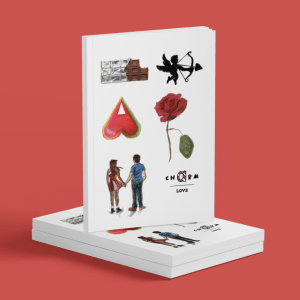
Charm’s most recent publication, CHARM: Love

MP: Do you and the students see any trends in the submissions to the anthologies lately? I saw “This is Not a Snow Day,” which documented quarantine life, on the site, and I thought that was interesting.

WWB: That actually morphed into our first hardcover book. So we came out with a book called Unmasked, and the students coordinated that throughout the seasons of Covid. Spring 2020, Spring 2021. It’s such a great documentation of not only living through that time period, but being a young person during that time period. The summer of 2020 is filled with lots focused around Black Lives Matter and things motivated by the George Floyd killing and protests happening around the country, so you can really feel the progression of that year. Back to your question, we have noticed a lot of writing that deals with the current world and what it’s like to live in this time. Two years ago, there were definitely some students who were like, “We really want to make sure we’re focusing on joy and fun because everything is so heavy. We want to counteract that. It doesn’t all have to be Covid and negativity.” And those particular students felt strongly that it was important to also be highlighting joy, and I think that’s important.

MP: Speaking of the political times we’re in, where do you see CHARM Lit Mag fitting in as a Baltimore publication? Grub Street’s also a Baltimore publication, so we know people always have a lot to say about Baltimore. I think a few years ago [Baltimore] got called rodent-infested. So where do you see CHARM Lit Mag in that Baltimore identity?

WWB: So, I’m from North Carolina, and I’ve been here now for almost 20 years, since 2005, and I think there’s something about Baltimore that people who live here are very fiercely protective of the city and its reputation. That idea that there is this narrative of Baltimore that isn’t true needs to be subverted, and the people who live here really know all the amazing and incredible things that are happening here. And I feel that very much with our students. I don’t know if there are other cities or towns where people feel that way. I think it’s kind of a unique thing for Baltimore. A lot of the work we publish is–whether intentionally or just sort of imbued with things about Baltimore–about the city and its challenges but also its beauty. That’s in its writing. 

One other thought I have about that is that during the pandemic, some of our students wanted to create a journalism arm of CHARM. So we actually have, in addition to our literary publications, The Charm Report. We have some local journalists who support our students learning about reporting. That’s newer, but it follows that model of instruction and supporting them as learning to become reporters, but also having the students really own [it]. What are the topics that you care about, what do you want to write about, what story needs to be told?

MP: Going off of that, are there any upcoming opportunities at CHARM you want to talk about?

WWB: Yes! So we have an open call for submissions for students K-12 about chaos. That closes in March and will be out this spring. We are gearing up for our summer publishing internship which will place 20 teenagers at local publishing and media sites all around Baltimore. Last year, we had students at The Baltimore Banner and The Afro, several local bookstores, and Hopkins Press. We’re really excited to be bringing that back. We also just moved into our new space at Baltimore Unity Hall, and we’re co-located with a bunch of other community arts and education organizations like Arts Every Day, No Boundaries Coalition, Community Builders. Now that we’re here, we have so many more opportunities for volunteers and workshops.


To learn more about CHARM, visit charmlitmag.org, find the organization on social media via @charmlitmag. 

Interview with Professor Jeannie Vanasco

This interview was conducted by Matti Ben-Lev and has been edited for clarity and length.

Prof. Jeannie Vanasco was the Grub Street advisor for four years. I thought she could provide some valuable insights and stories from her time working on Grub Street.

MBL: What was your favorite thing about working on Grub Street?

JV: My favorite thing was also the hardest: advising an entirely new staff each year. I enjoyed seeing how the different personalities and aesthetic styles of each staff shaped each issue. Some of the staff would change halfway through the academic year, and that challenged me as an instructor and an adviser. I was trying to teach my students developmental editing, copy editing, proofreading, and the history of the literary magazine, all while helping them assemble an issue. Not to mention I’m a terrible copy editor.

 MBL: Yeah, I had no idea what I was doing or what copy editing actually meant when I walked into class on the first day. I was placed in the poetry group and given five poems, and I just started editing them as if I had written them, which I quickly learned is not the goal whatsoever. I have learned so much about copy editing in just a few weeks, namely, what copy editing is

JV: As a writer, I feel deeply embarrassed whenever copy editors come back with corrections—like, I should know this stuff! But different publications have different house styles. The New Yorker, for example, puts a dieresis, which armchair grammarians mistake for an umlaut, over the second vowel in words such as cooperate, and I don’t have the mental equipment to fuss over stuff like that. Commas, sure. But a diaresis? Advising Grub Street, when I knew I was lacking in an area of experience, such as copy editing or publicity, I brought in experts. I got my start in editorial at The Paris Review, TriQuarterly back when it was a print-only publication, and the Poetry Foundation, but that was in 2006. When I was an assistant editor at Lapham’s Quarterly in 2008, someone suggested hiring a social media person, and we all laughed. So in doing Grub Street, I needed to lean more on the expertise of those currently working in the field. And maybe that was the most rewarding part of Grub Street:

Photo courtesy of Towson University.

introducing students to professionals. Some students even went on to work or intern at Graywolf Press, The Believer, CLMP [Community of Literary Magazines and Presses], and Simon & Schuster. A lot of students went on to fully funded MFA programs where they edited those schools’ journals such as George Mason’s So to Speak. I often encounter students who reject themselves before they even get the chance to be rejected. Seeing my students gain confidence is exciting. One of the best parts of teaching is when my students realize, “This is something I can do.” 

MBL: What does Grub Street mean to you? 

JV: What does it mean to you? 

MBL: Well, I think walking in, I started to realize that there is a true sense of agency. That students’ decisions actually hold weight. I haven’t experienced that level of agency in a class before. 

JV: That’s a great way of putting it. Grub Street is meaningful to me when students find it meaningful. I enjoyed it, but it was a lot of work. I’m still recovering. 

MBL: Do you plan to advise Grub Street again?

JV: Prof. Downs will do it for three years, then Professor Harrison, then maybe me again. But if somebody else wants to take it, I won’t fight them. If TU considered Grub Street the equivalent of two courses rather than one each semester (for students and the adviser), I’d love to advise it again. But maybe I took it too seriously. I remember handing out Grub Street tote bags to everyone on staff, and then, after some of the students didn’t carry them, I said: “I’m not saying you have to carry the tote bag—” As I was speaking, I was annoying myself. But I wanted students to think of Grub Street as a close community. That was what made the staff change midyear so difficult. I didn’t want the second-semester students to feel left out.

MBL: How was the first semester different from the second? 

Volume 71 of Grub Street, the most recent volume Vanasco has advised.

JV: The semester assignments differed on a practical level. Because Grub Street is a print annual, I believe the staff needs to accept some writing and art before the spring semester starts. Otherwise, you’re scrambling on editorial when you should be focused on production. So I asked students to make a list of dream authors, and emerging writers whose work the students loved in an online lit mag, such as G*Mob and Muzzle. The students wrote short explanations of what excited them about the work, and then they invited some of those writers to submit. The students needed to be very strategic about how many authors they emailed. It’s not a good look to ask a writer for work—especially if you’re not with an established journal—only to then reject it. So the genre editors kept track of solicitations. Some amazing writing came out of that assignment. Because the students personalized their emails to writers, almost all the writers replied. Some gave us a soft no, as in: “If I can get something to you before the deadline, I will.” Most, however, gave us an enthusiastic yes: “Oh my gosh, I’m living out of my car right now, but I’ll send you a batch of poems in a month when I have access to my computer again.” Having worked at different lit mags in my twenties, I didn’t want to rely on the slush pile.

Sometimes you miss out on great work because not all writers feel confident enough to submit in the first place, or they haven’t heard of Grub Street. I never want to dismiss the slush pile. The slush pile is crucial to the life of literary magazines. I believe that literary magazines have a responsibility to at least try to discover new writers. The first semester also involved studying the history of American literary magazines and presenting on contemporary ones. I also asked students to research defunct literary magazines. Just because a magazine ends does not mean it failed. Everything has a lifespan. A literary magazine doesn’t have to exist for fifty-some years. Maybe it will exist for one issue, and that’s okay. Oh, and something else we talked about first semester: you are not going to love or even like everything we accept for the issue. But that’s what I love about literary magazines in general. They’re much humbler than, say, a Norton anthology. An anthology seems to say: “You must love this.” A lit mag seems to say: “Here’s a bunch of stuff we liked.” 


MBL: Yeah, personally I walked into Grub Street’s second semester and saw some poems (one in particular) and thought, “You really accepted these?” 

JV: I definitely get that. When my students loved something from the slush pile that I didn’t, I’d suggest they hold off until more submissions arrived. I tried to resist that urge, but sometimes I couldn’t—partly because we had only so much space in the print edition. I’d suggest they save that work in case another writer pulled their work after it’d been accepted. 

MBL: That actually happened in our class! Two poems were pulled by the writer, and we can’t replace them with other submissions because those writers have already been informed that their submissions didn’t make it in. 

JV: That’s stressful. When I interned at The Paris Review, the editors accepted a short story that would have been the writer’s first publication, but in the meantime the writer had already given the story to a very small lit mag in Texas. I say given because the Texas journal couldn’t pay, whereas The Paris Review would have paid hundreds of dollars. Maybe more than a thousand. After the Paris Review editors informed the writer of the acceptance, the writer apologized for the simultaneous submission. Everybody at The Paris Review felt deep respect for that writer. After all, a Paris Review publication for a debut writer can be life-changing. It can lead to an agent or a book deal. Plenty of other writers would have pulled their story from the Texas mag, but this writer didn’t. We all have to live under capitalism, so I get why well-meaning writers might pull work from journals that don’t pay. And I of course understand why writers often submit to many journals at once. A journal’s editors can take months and months to get back to you. Sometimes the editors never reply. But when you’re on the editorial side, you often forget what it’s like for the writers. 

MBL: I think many of us come at it from the same angle as applying to universities. You apply to a bunch, and you have your dream school, safety school, etc. Did working on Grub Street change your writing in any way? 

JV: I’m a slightly better copy editor. Then again, I’m not sure if it’s one word or two. I don’t know if copy editors have collectively decided.

MBL: Thanks so much for your time! 


Jeannie Vanasco is the author of the memoirs Things We Didn’t Talk About When I Was a Girl—which was named a ​New York Times Editors’ Choice and a best book of 2019 by TIME, Esquire, Kirkus, among others—and The Glass Eye, which Poets & Writers called one of the five best literary nonfiction debuts of 2017. Her third book, A Silent Treatment, is forthcoming. Her work can be found at https://www.jeannievanasco.com/ 

Born and raised in Sandusky, Ohio, she lives in Baltimore and is an associate professor of English at Towson University. 

A Conversation with Ashley Hajimirsadeghi

This interview was conducted by Madisyn Parisi, Chief Copyeditor of Grub Street, and has been edited for clarity and length.


Ashley and I met up on a chilly October afternoon. She had come straight from her job at Towson’s career center, and we trudged up three flights of stairs in Towson’s commons to find a quiet place to talk about her writing. I was excited to dive into her vast collection of work, and before we even found a table, we had struck up a conversation about multimedia work, men who get mad at her on the internet, and The Dropout on Hulu.

MP: So I guess just starting off, when you sit down to write a poem, where do you start developing that idea? Do you usually have a line or a concept?

AH: For me, I get obsessed with a very singular image or word, and then I build the entire poem or piece around that. Like I was writing this flash fiction piece the other day, and I was really thinking about the Iranian women’s movement and burning film reels, so then I combined those two to create a flash fiction/poetry piece that was based completely around that image. Going back to edit, I wanted to keep that central. I don’t cut that out.

MP: Do you feel like you ever take a different turn from that initial image or realize something’s not about what you thought it was about?

AH: It depends on the way the story and narrative turns out, but I’ll go back and edit and see how the story grows. Sometimes our children grow up, and they don’t become what you expect them to be, and we have to adapt to that.

MP: You have to love them anyway?

AH: Yeah.

MP: Most of your poetry is in the first-person. When you write, is that speaker generally you, a character, a combination of both?

AH: It’s not me. I like to use “I”, and I’ve been switching more to “you” lately because it’s more interrogative — like, you, look at yourself. But I tend to use “I” because I feel like that drops the reader into the narrative. “I” is someone who’s real because if you say “she” or “they”, anything, they’re not a real person to the reader. Also, I tend to use very fictionalized versions of my own life. I’ll take pockets of things that I’ve experienced, then blow it into something fictionally-spun.

MP: So you’ve published two chapbooks now, cinephile and cartography of trauma. Did your process change a lot between the two of them? Do you feel like they taught you different lessons?

AH: I think for me, especially because I’m in grad school studying the world a bit more — cartography of trauma, a lot of it was poems from high school. That’s the interesting part. Poems from cinephile were like sophomore year of college, so just growing up and being like… I wanted to sell some stuff because I did a lot of Sylvia Plath, Anne Sexton confessional-style poetry when I was in high school. Then I was like, “I want to see beyond myself, see how I interconnect in a broader way. Like, what does it mean to be a woman in the US? What does it mean to be an Iranian-American woman? What does it mean to be a woman in the world?” Seeing how to use poems. And that adjusted my style because then I realized, hey, a lot of the time in writing classrooms we’re taught a very Western-specific way of writing. So I started reading poems from traditional Chinese, Afghan, and Persian poetry, trying to break free from the conventional western mode of storytelling. Because even in a novel, the way we think of the three-act structure, that’s only in the West, that’s a Greek thing. In China and East Asian literature, it’s just a rise and fall. A rise and fall. So my technique has been more informed by being a quote-unquote “global citizen”.

MP: Do you travel a lot?

AH: Yeah, I lived in Korea for a bit. I was posted in India last summer. I went to the Caribbean a lot growing up, and I’m a global humanities student now, so I study the world and world literature. But I hope to travel more. I grew up low-income, so we never really got the opportunity to travel, and I got these state scholarships to go other places and learn about other people, and that changed my life. 

MP: Being Iranian-American is a pretty central part of your identity and your voice. Are there specific parts of your writing that you trace back to that identity?

AH: I feel like there’s this inherent sadness that comes with being Iranian-American because you see what’s happening in Iran right now to women and even growing up in the diaspora, a lot of the men treated women horribly. Especially in the community I grew up in, abuse was normal. So I really decided in my work that even though I’ll acknowledge the male perspective, I want to ground myself in women’s voices because they’re not allowed the chance to speak often.

MP: I get the impression cartography of trauma is about all that, right?

AH: Kind of. But also just thinking about…women’s history is so messed up.

MP: A lot has happened. So when you write, you want to give voice to that female perspective. Do you want that same thing for your audience? Is your audience young women, Iranian-American women?

AH: I think it would be women in general. I hope men can read this and be like, “Wow, this sucks”, but I also give a lot of people too much credit. Yeah, no, they’re not going to. But I am thinking a lot right now about how niche certain genres are. Like poetry. People say, “Oh, it’s too hard to understand.” So, I’ve been thinking about accessibility in poetry and writing in general. People are like, “Yeah, I don’t read. I just watch Tiktok.” So just thinking about how to make it more accessible in a way that people will see it. Social media’s playing a big role. But also using big words and stuff, people won’t understand.

MP: I was going to say, your work isn’t very lofty like something you might expect from someone with your degrees and writing history. It’s very easy to understand.

AH: Well, I came from working-class parents. I wasn’t exposed to theater or art or poetry growing up. I never even took a writing class until I went to Carver down the street. So, just growing up working-class, and also not taking writing classes in undergrad. That shapes you. When you take a lot of writing classes, and you’re taught, “This is how you should write.”

MP: You don’t become a workshop writer or an MFA writer. You become something else.

AH: Yeah. So it’s about self-education but also this idea of — I think this about academia too — PhDs and all that, a lot of that stuff isn’t accessible. It’s written in a way you can’t understand it. It’s only for academics.

MP: So do you like that you’ve found yourself in a different space than that?

AH: Yeah, even though it’s hard. It’s unconventional. A bit of a rough way to get published. Because you see people younger than you getting published because they subscribe to the model. For me, it’s realizing it’s a process. Like Toni Morrison wasn’t automatically famous, she was  like 38 [39]. 

MP: But you’re also in this Instagram space. I feel like the poetry community at large hates “Instagram poetry.” Rupi Kaur, those sorts. Do you consider yourself in line with those poets, do you think you’re doing something else?

AH: I don’t really like Instagram poetry because it’s bite-sized, and a lot of it doesn’t have depth. And also Rupi Kaur was accused of plagiarizing a lot of her work. So, it’s good to share information that way, but it’s also dangerous, too. It’s kind of like seeing Facebook news and believing it’s all true.

MP: So a lot of your life right now is about writing — you’ve got Mud Season, your poetry, reviews — what do you do right now when you’re not writing, to refill the well or just take a break? … Do you take breaks? You’re looking at me like you don’t.

AH: I do like to read, but at the same time it is kind of studying. So I guess you could consider it not work, but I do genuinely enjoy it. 

MP: Is that about the furthest you ever get from writing?

AH: I used to watch movies, but now it’s my job… it’s not as enjoyable anymore. I garden, too. I like to grow our own food. It’s very serene. There’s one writer in the Caribbean, Jamaica Kincaid, who writes a lot about gardening.

MP: I feel like there’s a lot of metaphor you could get out of that. 

AH: Yeah, definitely. There’s this book called Orwell’s Roses by Rebecca Solnit. She wrote about George Orwell. He had an obsession with his rose garden. He saw it as an allegory for the end of the world. It’s very fascinating how people get attached to their gardens.

MP: Talking about that Orwellian idea, I think a lot of people in the world right now, especially writers, feel that sense of doom about the world and their work. Do you feel that way, or do you think you write with optimism?

AH: People tend to think my work is very pessimistic and sad, but I tend to look at it as progress and optimism. I work part-time at New Perspectives Theatre Company. I spent this whole two years building a database of women playwrights. A lot of these women were forgotten. Their stories never had the chance to be told. If they did write plays, they were considered dainty, feminine, docile. Seeing all these playwrights across the world made me realize that a lot of them were writing about women’s issues at the time, so the fact that I can have a platform to put my work on, or even write it, feels like hope to me. Because if that’s ever taken away from us, then what’s the point?

Ashley Hajimirsadeghi is an Iranian-American multimedia artist, writer, and journalist. Her writing has appeared, or is forthcoming, in Moon City Review, The Cortland Review, DIALOGIST, RHINO, Salt Hill, and The Shore, among others. She is the Co-Editor-in-Chief at Mud Season Review and a contributing writer and critic at MovieWeb. Her work can be found at ashleyhajimirsadeghi.com