
networking
Teens’ Social Media Habits and Experiences

Teens credit social media for helping to build stronger friendships and exposing them to a more diverse world, but they express concern that these sites lead to drama and social pressure.
Source: Teens’ Social Media Habits and Experiences | Pew Research Center
Google My Business app revamp challenges Facebook Pages
Google is giving its business customers a new way to reach their customers. The company is today starting the rollout of a revamped Google My Business mobile application for iOS and Android that will offer new tools for viewing customer info – including followers, reviews and messages – as well as a way to quickly […]
Source: Google My Business app revamp challenges Facebook Pages | TechCrunch
Facebook’s Lasso App Tries To Win Teens Back With Music and Video

Facebook continues its Myspace-esque quest of injecting social media with video and music, this time with a TikTok imitator.
Source: Facebook’s Lasso App Tries To Win Teens Back With Music and Video – Rolling Stone
The Instagrammers Next Door, Plugging Brands for Peanuts (or Shampoo)

Influencers are so 2014. And microinfluencers are so last week. Now advertisers see value in people with as few as 1,000 followers: the nanoinfluencers.
Source: The Instagrammers Next Door, Plugging Brands for Peanuts (or Shampoo) – The New York Times
The one graph that Facebook didn’t present to investors and Wall Street last week proves it is dying
Graph shows the year-over-year change in user engagement, Daily Active Users/Monthly Active Users (DAU/MAU).
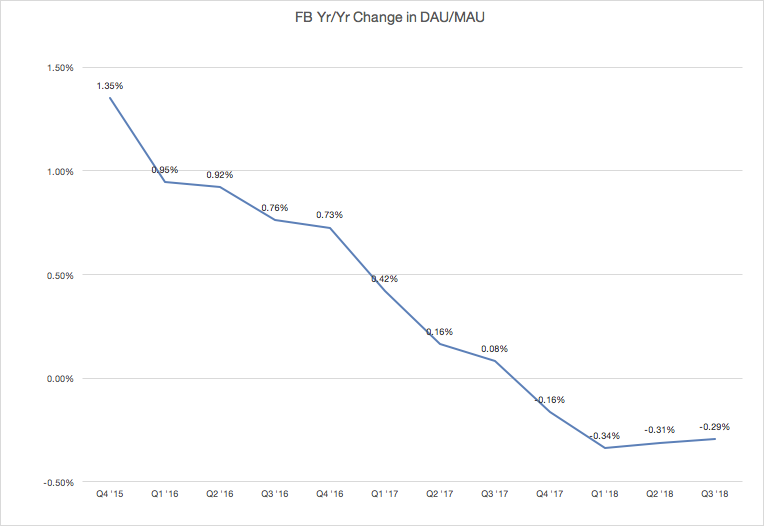
Facebook is dying. At the moment, it’s a slow death, but at some point, it will accelerate. That’s what social networks do. They grow engagement, until they don’t. Interestingly, Facebook blames the drop on engagement on the fact that they are trying to stop people from being able to do the thing people like to do most on Facebook . . . read fake news.
How Many People in the US Use Snapchat
This year, 84.8 million people in the US—or roughly a quarter of the population—will use Snapchat, a 7.1% increase from 2017, according to eMarketer estimates.
Source: How Many People in the US Use Snapchat – eMarketer Trends, Forecasts & Statistics
Minorities Who ‘Whiten’ Job Resumes Get More Interviews
African American and Asian job applicants who mask their race on resumes seem to have better success getting job interviews, according to research by Katherine DeCelles and colleagues.
Source: Minorities Who ‘Whiten’ Job Resumes Get More Interviews
Delete Your Account Now: A Conversation with Jaron Lanier

JARON LANIER IS ONE of the leading philosophers of the digital age, as well as a computer scientist and avant-garde composer. His previous books include Dawn of the New Everything: Encounters with Reality and Virtual Reality, Who Owns the Future?, and the seminal You Are Not a Gadget: A Manifesto. His latest book bears a self-explanatory title: Ten Arguments for Deleting Your Social Media Accounts Right Now.
Source: Delete Your Account Now: A Conversation with Jaron Lanier – Los Angeles Review of Books
The Inscrutable Rise of the Online ‘Influencer’

‘Influencing’ online has something to do with money, power, and popularity, with brand identities and likes. But when you get down to it, the influencer is pretty hard to picture.
The web is broken, so its founder is taking another stab at it

Tim Berners-Lee has a new venture.
Source: Tim Berners-Lee’s Solid and Inrupt let people control their own data — Quartz
Use of internet, social media, digital devices plateaus in US

The shares of U.S. adults who say they use the internet, use social media, own a smartphone or own a tablet computer are all nearly identical to the shares who said so in 2016.
Source: Use of internet, social media, digital devices plateaus in US | Pew Research Center
Instagram Is Too Big Not to Mess With

With the photo app’s founders gone, Facebook is likely to change it significantly.
Source: Opinion | Instagram Is Too Big Not to Mess With – The New York Times
How Connected Is Your Community to Everywhere Else in America?
America is often described as a place of great divides — between red and blue, big cities and rural towns, the coasts and the heartland. But our social lives are shaped by a much stronger force that ignores many of these lines: distance.

In the millions of ties on Facebook that connect relatives, co-workers, classmates and friends, Americans are far more likely to know people nearby than in distant communities that share their politics or mirror their demographics. The dominant picture in data analyzed by economists at Facebook, Harvard, Princeton and New York University is not that like-minded places are linked; rather, people in counties close to one another are.
Even in the age of the internet, distance matters immensely in determining whom — and, as a result, what — we know.
Source: How Connected Is Your Community to Everywhere Else in America? – The New York Times
The Dangers of Digital Activism

Social media has been a significant tool for activists in the Middle East. But do the risks now outweigh the benefits?
Source: Opinion | The Dangers of Digital Activism – The New York Times
News Use Across Social Meda
Most Americans continue to get news on social media, even though many have concerns about its accuracy.
Source: News Use Across Social Media Platforms 2018 | Pew Research Center
Four reasons Snap’s stock price is at an all-time low

Snap’s stock price hit an all-time low as a public company this week, closing last Friday under $10 per share — more than 60 percent below the company’s first day of trading 18 months ago.
Source: Four reasons Snap’s stock price is at an all-time low – Recode
Facebook beats Twitter at fighting fake news, a new study found

But there’s still plenty of it on both platforms
Source: Facebook beats Twitter at fighting fake news, a new study found – The Verge
The Hacking of America

Political and technological destabilization have fed off each other since the nation’s founding. Now they are dangerously out of whack.
Source: Opinion | The Hacking of America – The New York Times
Teens are hooked on social media. But how does it make them feel about themselves?

Broadly, teens seem aware of the negative consequences of too much social media use:
-
Nearly three-quarters of teens believe that tech companies are manipulating users to spend more time glued to their devices.
-
More than half of social media users say it distracts them from doing homework or paying attention to the people they’re with.
-
Some 21 percent of teens say using social media makes them feel more popular, 20 percent said more confident, and 18 percent said it makes them feel better about themselves.
-
A quarter said it makes them feel less lonely, and 16 percent said it makes them feel less depressed.
-
Some 8 percent said it makes them feel more anxious, but 12 percent said less anxious.
Source: Teens are hooked on social media. But how does it make them feel about themselves? – Recode
The Safebook extension removes all the content from Facebook

Treat yourself to a benign cruise through blue-gray boxes, with nary a notification in sight.
Source: The Safebook extension removes all the content from Facebook